
The Euda AI Readiness Profile: The eight dimensions up close
Third in a series introducing the Euda AI Readiness Profile
By Keegan Evans
My last post shared how we think of AI Readiness in two forces, Lift and Drag, and how they form the top and bottom halves of our instrument dial.

We also organized the dial with a themed split from left to right.

The left half is your People & Culture: how people approach AI and how they interact with it as a teammate.
The right half is your Systems & Work: how AI gets built into accountable, well-run operations.
Each half holds two Lift dimensions and the two Drag mirrors that oppose them. As with Lift and Drag, we capture ratings in each dimension as well as the balance between the two sides.
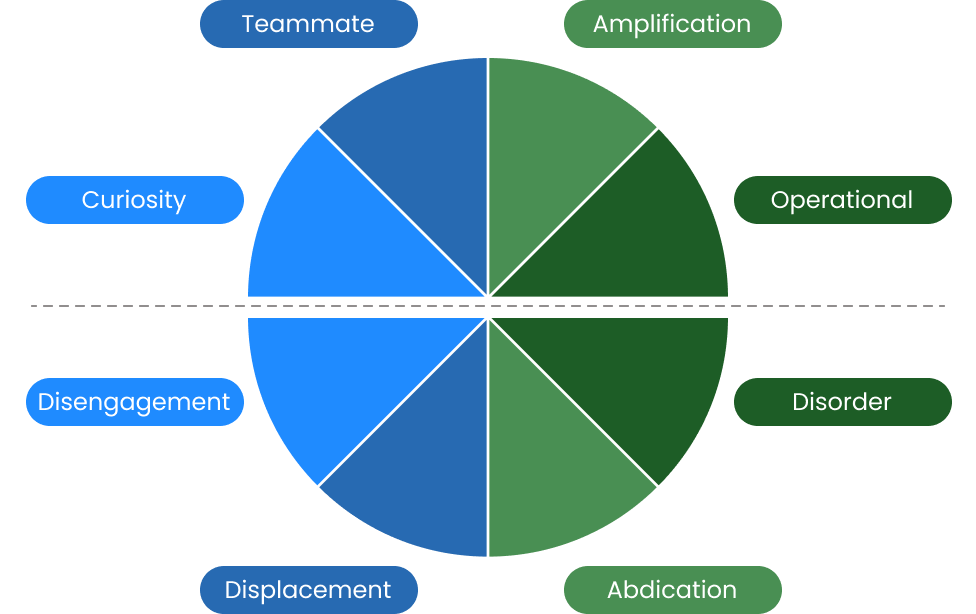
As a reminder, these eight dimensions are our current working model, measured through structured survey reports and refined as we validate them against real outcomes.
People & Culture
The left half captures what can sometimes feel less tangible. How are people really feeling about AI within their teams, what attitudes do they bring toward learning it and new ways of working, and what skills are they developing or allowing to atrophy?
AI Curiosity is the first dimension based on our Core Principles of AI Adoption. Successful teams approach AI with a continuous learning mindset. This dimension measures your organization's habit of experimentation and learning, made safe by enabling guardrails, broken into four outer dimensions: Experimentation, Learning Orientation, Psychological Safety, Enabling Guardrails
Directly across from Curiosity is Disengagement. Here we look at the fear-driven, imposed, or resigned patterns that pull people back from openly adopting AI, whether that shows up as avoiding it or, as with Hidden Usage, using it constantly in the shadows where no one can learn from it. The pattern protects people from perceived threat; its gift is that it marks exactly where trust must be built. Disengagement is further broken down into three outer dimensions of Replacement Anxiety, Hidden Usage, and Resigned Compliance.
AI as a Teammate is our second culture related Lift dimension. Because AI has a “jagged frontier” of capabilities, it’s more like a talented but imperfect team member, and we apply the same leadership principles that make human teams effective. This dimension understands how well your organization is using The Core Three: trainable, assessable capabilities for leading AI as a teammate (derived from aviation's Crew Resource Management framework):
Assertiveness: The ability to clearly and accurately send and acknowledge information, and the willingness to actively participate, state positions, and maintain them until convinced by facts that other options are better.
Situational Awareness: The degree of accuracy by which one’s perception of reality mirrors actual reality.
Decision Making: Choosing a course of action using logical and sound judgment based on available information.
Across from AI as a Teammate is Displacement, where we measure the tricky balance of AI substituting for human judgment, skill, connection rather than amplifying them. This is distinct from automating drudgery, and we look for the failure mode where AI is substituting for people inappropriately. Specifically, the outer dimensions here are Uncritical Trust, Deskilling, Eroded Connection, and Replacement Posture.
Systems & Work
The right half is about structure: how intentional you are with your operations, IT infrastructure, the day to day conduct of your business, and generally setting your people up for success when leveraging AI.
Amplification focuses on achieving more in the right places and right ways, where people grow more capable with AI and maintain their responsibility for the outcomes. This requires more than just a values message on the wall; it’s about how leaders are clear about expectations and guardrails, and consistent behaviors which reinforce the intended culture. To score this, we evaluate Accountability for Outcomes, Collaboration Design, and Active Oversight.
Mirroring our final Core Principle, Abdication sits across from Amplification. Abdication happens when responsibility for outcomes is surrendered to the system or technology. To measure this, we look at reports of Over-delegation, Moral Outsourcing, and Rubber-stamp Review. Furthermore, we measure Decision Exposure: to what degree decisions are handed to AI beyond what their severity and reversibility allow, including the small decisions an AI agent now makes inside a task you've handed it. This includes insight into Decision Opacity, or how well your organization understands what and how decisions are handled.
Operational Readiness is the organizational foundation on which AI work stands. Its outer dimensions are Workflow Clarity, Strategic Alignment, Data Readiness, and Impact Measurement. Curiosity without the groundwork to support it will evaporate into disengagement.
Across from Operational Readiness is Disorder, in which we capture the ungoverned effects of speed without stewardship: Pilot Sprawl, Tool Chaos, and Unmeasured Impact.
No single score is the point. What the two halves show you is where real strength and a real pull sit in the same organization at the same time, and where the people at the top and the people on the floor are reading it differently.
The free Readiness Check gives you your own starting point in about three minutes: your readiness stage, and your archetype, written for the strength you bring rather than a box you fall into. It's also how you get in line for the founding cohort, which opens July 27; your results open the door to early access for the full Profile.